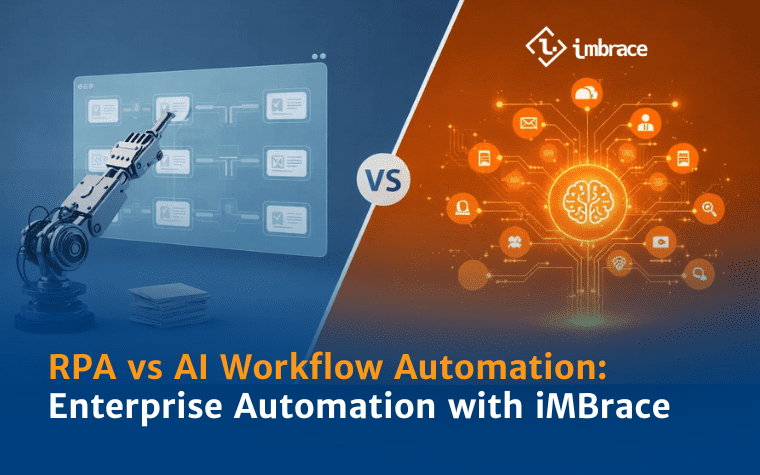

In today’s fast-paced business environment, organizations face the constant challenge of handling large volumes of unstructured data — invoices, contracts, emails, customer forms, and more. Robotic Process Automation (RPA) has long been used to automate repetitive, rule-based tasks like copying data, clicking buttons, and filling forms. Tools like UiPath and Power Automate are great for automating isolated tasks, but they struggle when it comes to more complex workflows that involve multiple systems or require decision-making.
As Deloitte highlights, AI-powered automation, combined with human oversight, can transform business operations and improve decision-making across industries. McKinsey reports that over 90% of senior executives plan to digitize workflows using AI by 2026, signaling a shift toward intelligent, integrated automation solutions.
Enterprises need platforms that not only execute tasks but also understand context, integrate systems, and optimize workflows across the organization. That’s where iMBrace comes in, providing a comprehensive enterprise automation platform with advanced AI workflow solutions.
RPA vs iMBrace: Key Differences
In the world of enterprise automation, RPA (Robotic Process Automation) and iMBrace offer distinct approaches. Here’s a clearer breakdown to help you understand the key differences:
|
Category |
RPA (UiPath / Power Automate) |
iMBrace |
|
Core Purpose |
Automates isolated tasks like data copying or form filling |
Automates entire business processes, integrating systems and decisions |
|
Main Capability |
Simple task automation |
AI-driven orchestration and decision-making across systems |
|
Best For |
Repetitive, rule-based operations |
Complex workflows involving multiple systems and decision flows |
|
Data Handling |
Basic data extraction and task automation |
AI parsing, knowledge hub (RAG), structured output |
|
Integration |
UI-based automation (API optional) |
API-first, system-to-system integration |
|
Scalability |
Adding more robots increases both licensing for robots and Microsoft, as well as hardware. |
Scalable cloud/on-prem/hybrid solutions |
|
Weakness |
Breaks with UI changes |
Needs upfront workflow design but offers long-term stability |
Real-World Use Case Differences
The distinction between RPA and iMBrace becomes clearer in practice:
Purchase Orders
Category | RPA | iMBrace |
Core Purpose | Automate repetitive data entry tasks | Automate end-to-end purchase order validation and posting |
Main Capability | Rule-based data extraction and form filling | AI-driven document understanding, validation, and orchestration |
Best For | Standardized, high-volume PO formats | Complex, multi-vendor POs with validation requirements |
Data Handling | Structured or semi-structured only | Structured, semi-structured, and unstructured data |
Integration | UI-based automation (screen scraping) | Native API integration with SAP and enterprise systems |
Scalability | Limited by rule maintenance and UI changes | Scales across formats, vendors, and business rules |
Weakness | Breaks when formats change; high error rates | Requires upfront configuration of business logic |
Email Ticket Handling
Category | RPA | iMBrace |
Core Purpose | Transfer email data into systems | Manage and automate email-driven workflows |
Main Capability | Copy-paste automation | AI classification, routing, and SLA tracking |
Best For | Simple, repetitive email templates | High-volume, multi-topic customer or internal emails |
Data Handling | Text extraction without context | Intent, sentiment, and metadata understanding |
Integration | Email clients and ticketing systems via UI | APIs across CRM, service desk, and workflow tools |
Scalability | Degrades as email variations increase | Improves with learning and knowledge enrichment |
Weakness | Cannot prioritize or reason | Requires quality training data for best results |
Customer Inquiries
Category | RPA | iMBrace |
Core Purpose | Automate responses to predefined questions | Deliver intelligent, context-aware customer engagement |
Main Capability | Triggered responses based on keywords | Knowledge Hub + AI chat for personalized replies |
Best For | FAQs with fixed answers | Complex inquiries requiring context and history |
Data Handling | Keyword or rule-based matching | Semantic understanding and contextual reasoning |
Integration | Limited CRM or email system triggers | Deep CRM, knowledge base, and workflow integration |
Scalability | High maintenance as scenarios grow | Adapts to new questions with minimal rule changes |
Weakness | Poor handling of ambiguity | Needs governance to ensure response accuracy |
Approval Workflows
Category | RPA | iMBrace |
Core Purpose | Execute predefined approval steps | Orchestrate intelligent decision workflows |
Main Capability | Scripted task execution | Human-in-the-loop, escalation, and audit management |
Best For | Linear, predictable approval chains | Exception-heavy, regulated approval processes |
Data Handling | Pass-through data handling | Decision-aware, context-rich data processing |
Integration | UI-driven approvals | APIs across ERP, compliance, and workflow systems |
Scalability | Fragile as complexity increases | Designed for enterprise-scale governance |
Weakness | Cannot handle exceptions or judgment | Requires process redesign for full benefit |
How iMBrace Transforms Industries with AI-Powered Automation
iMBrace is an AI Collaboration Operating System designed to orchestrate enterprise workflows, decisions, and human-AI collaboration.
Unlike traditional RPA, which automates tasks like a digital worker, one of iMBrace’s core modules, FlowOps™, automates entire workflows — from document extraction and context understanding to intelligent decision-making and seamless system integration.
Here’s how iMBrace adds value across industries with end-to-end process automation and AI-driven decision-making:
- End-to-End Process Automation: iMBrace manages processes from input to completion, automating repetitive tasks while coordinating complex decisions.
- Real-Time Analytics & SLA Tracking: Provides executives with visibility into operational performance, workflow bottlenecks, and efficiency metrics.
- Human-in-the-Loop Validation: Ensures oversight for critical decisions, combining AI speed with human judgment.
- Multi-System Integration: Seamlessly connects enterprise systems, enabling cross-departmental workflows and reducing fragmentation.
iMBrace: Six Core Modules Driving Enterprise Intelligence
Built on Six Core Modules — CommsIQ™, DocIQ™, InsightsIQ™, FlowOps™, OntoCore™, and GovernCore™ — iMBrace empowers businesses to transform workflows with intelligence at every step.
These modules work in harmony to reduce manual intervention, improve decision-making, and streamline operations across systems.
- CommsIQ™: Facilitates seamless communication across multiple channels for enhanced customer interaction.
- DocIQ™: Automates document processing, from extraction to validation, ensuring data accuracy and efficiency.
- InsightsIQ™: Provides actionable insights that drive smarter, data-driven decision-making.
- FlowOps™: Ensures smooth orchestration of human-in-the-loop processes, making decision-making more efficient.
- OntoCore™: Understands and processes unstructured data, helping businesses harness the power of context-aware automation.
- GovernCore™: Ensures governance, compliance, and security across all automated workflows, protecting your enterprise’s data integrity.
Conclusion: iMBrace – Beyond RPA, A New Era of AI-Powered Automation
iMBrace redefines enterprise automation by integrating AI-driven orchestration and end-to-end process automation. It goes beyond simple task automation, orchestrating complex workflows and driving business outcomes with smarter, more efficient processes.
RPA automates actions. iMBrace automates processes. RPA handles repetitive tasks, while iMBrace orchestrates and integrates entire workflows, driving intelligent outcomes across the organization.
“The true value of AI lies not in automating individual tasks, but in orchestrating entire processes that integrate systems, decisions, and human oversight to deliver scalable and intelligent outcomes.”
— The 2026 State of AI Agents Report
Transform your enterprise application with iMBrace today. Contact us to learn how iMBrace’s AI-powered solutions can streamline your business operations and drive smarter decision-making.