From Human-in-the-Loop to Human-on-the-Loop: How iMBrace Helps Banks Put the HKMA’s ART Framework into Practice

AI That Acts Needs a New Rulebook
For most of the past two years, banks used generative AI to answer questions: summarising documents, drafting replies, and helping staff find policies faster. That is changing quickly.
Recently, the Hong Kong Monetary Authority (HKMA) announced its “ART” Framework to help banks capture AI’s opportunities while keeping governance and operational resilience strong. The framework was introduced at the Finance + A.I. Forum, co-hosted by the HKMA and Cyberport.
The timing reflects what is happening in practice. In the second cohort of the HKMA’s GenAI Sandbox, more than 60% of use cases involved AI agents, and half of those were multi-agent applications. These systems do more than produce content. They can plan multi-step tasks, use tools, access data and systems, and act with a high degree of autonomy.
The results are significant. One bank cut customer-onboarding time by 40% through better fraud detection, and a market-risk agent shortened case-specific risk analysis by 95%. Banks are no longer asking whether AI can help. They are asking how to supervise AI that acts.
What the ART Framework Asks of Banks
Accountability
For agentic AI, the HKMA says governance must be “anchored to intent.” Banks should be clear about what each agent is meant to achieve, and that purpose should carry through its design, data, the tools it can use, and the actions it can take. The guidance also expects clear ownership of every AI use case and an up-to-date inventory of approved applications.Resilience
Banks are expected to map their AI dependencies, with clear lineage across models, data, tools, infrastructure, and third-party providers. They also need response and recovery measures ready, which may include “kill-switch” mechanisms that suspend an agent before an issue escalates.Trust
Trust begins with securing the boundaries around an agent, often called the agent harness. In banking, that harness should translate the institution’s risk appetite into clear limits on what the agent can do. Trust is also built through observation, including testing how agents behave in extreme scenarios.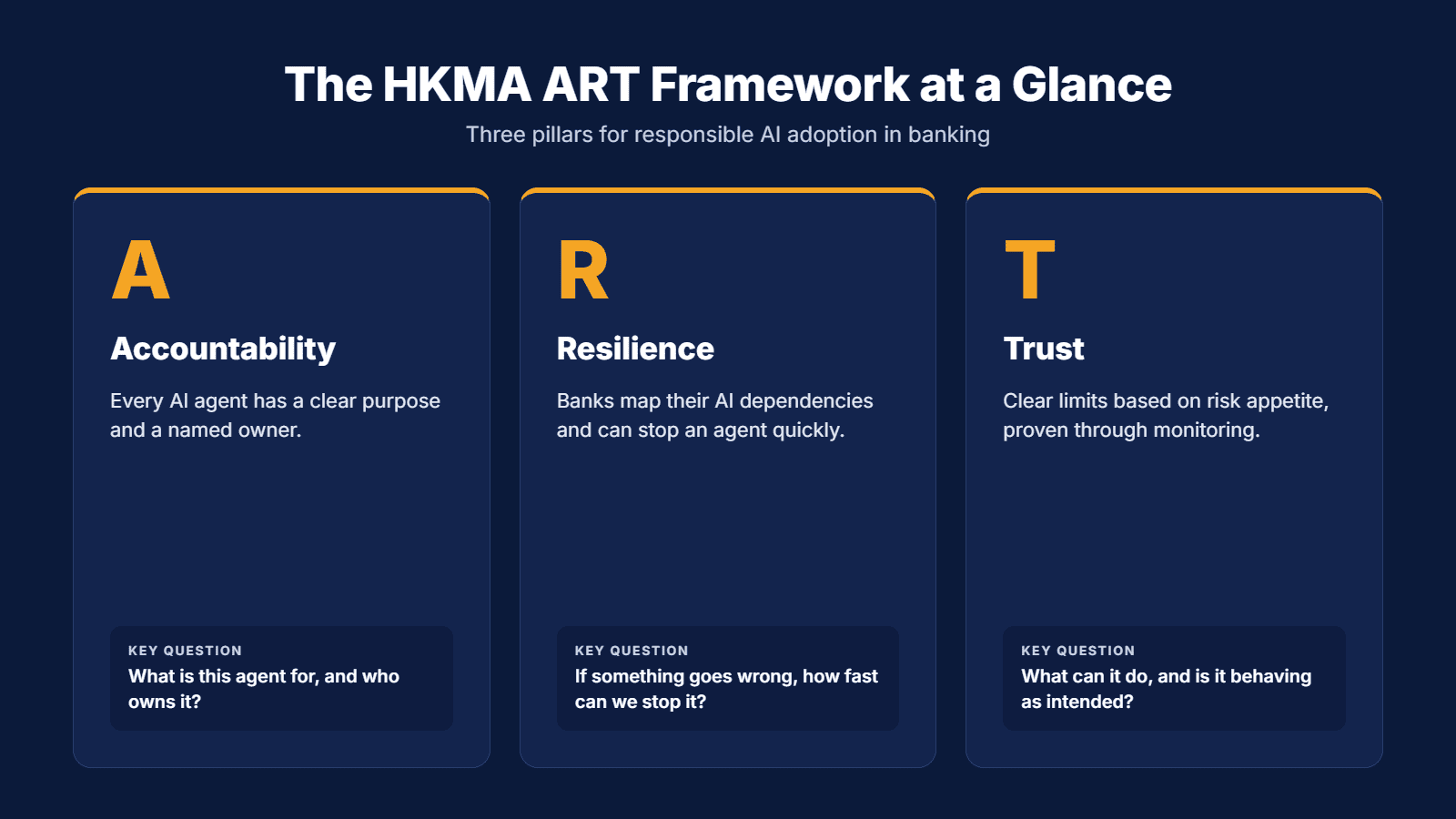
The Shift: From Human-in-the-Loop to Human-on-the-Loop
The most consequential idea in the new guidance is a change in how oversight works. The HKMA recognises a progressive shift from “human-in-the-loop” to “human-on-the-loop” oversight.
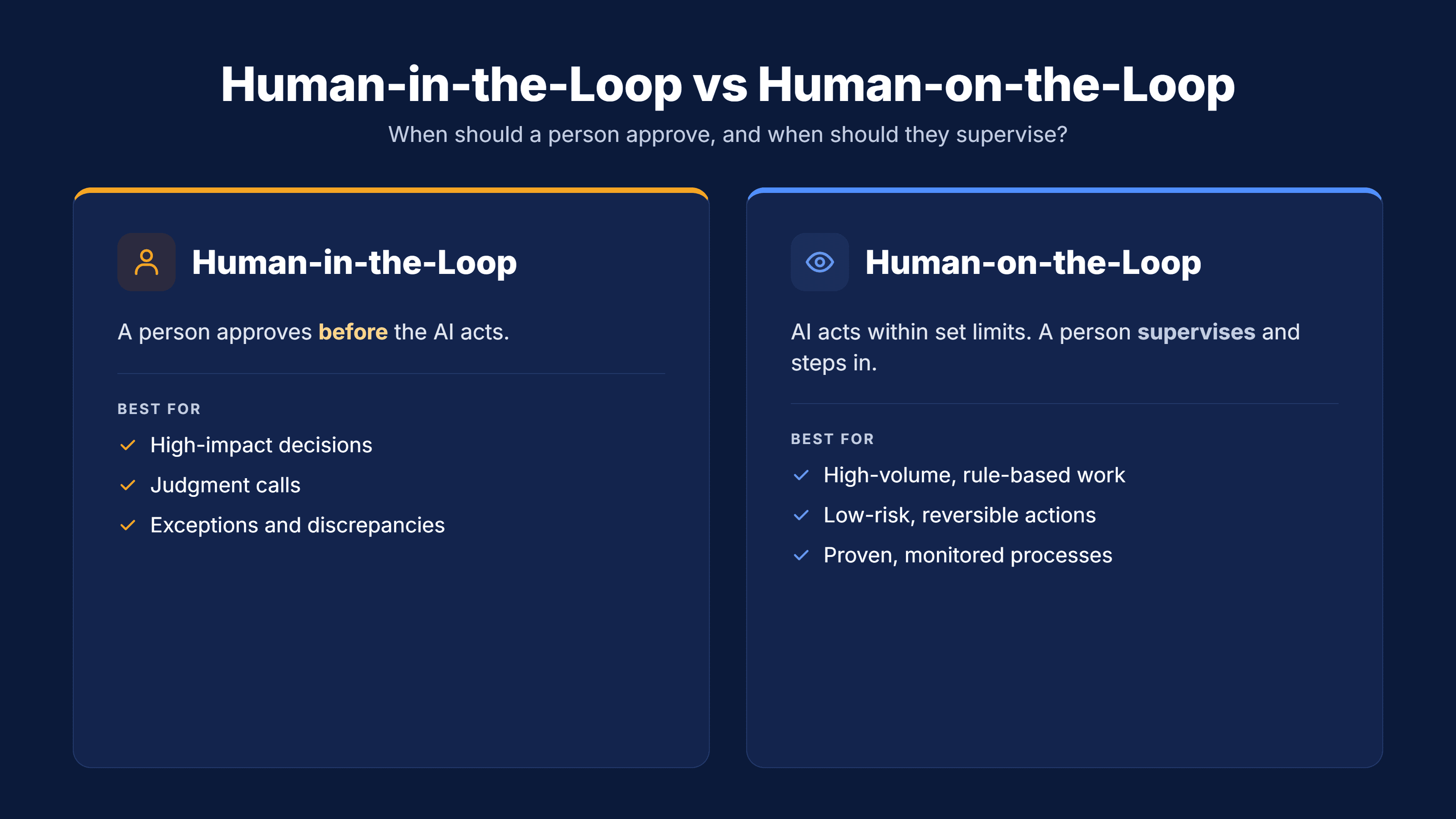
Human-in-the-loop (HITL) means a person approves each step before it happens. That gives strong control, but it does not scale. When an agent runs a multi-step journey across several systems in seconds, the reviewer becomes the bottleneck, and routine approvals soon turn into rubber stamps.
Human-on-the-loop (HOTL) means the AI operates within defined boundaries while people monitor its work, handle exceptions, and step in when needed.
This does not lower the bar. Oversight need not mean human involvement at every step, but it does require clear accountability and continuous monitoring. Each workflow earns the shift step by step, once its limits are set, its controls are tested, and the agent is shown to behave as intended. Oversight must also cover the whole business journey, not individual prompts, or gaps open up between them.
How iMBrace Fits: Governing Both Modes on One Platform
iMBrace is a private Enterprise AI Operating System. Its Govern core sits beneath every workspace, agent, and workflow, so a bank can decide, step by step, which work the AI completes on its own and which work waits for a person. Here’s how that works when checking Letter of Credit (LC) documents in trade finance.
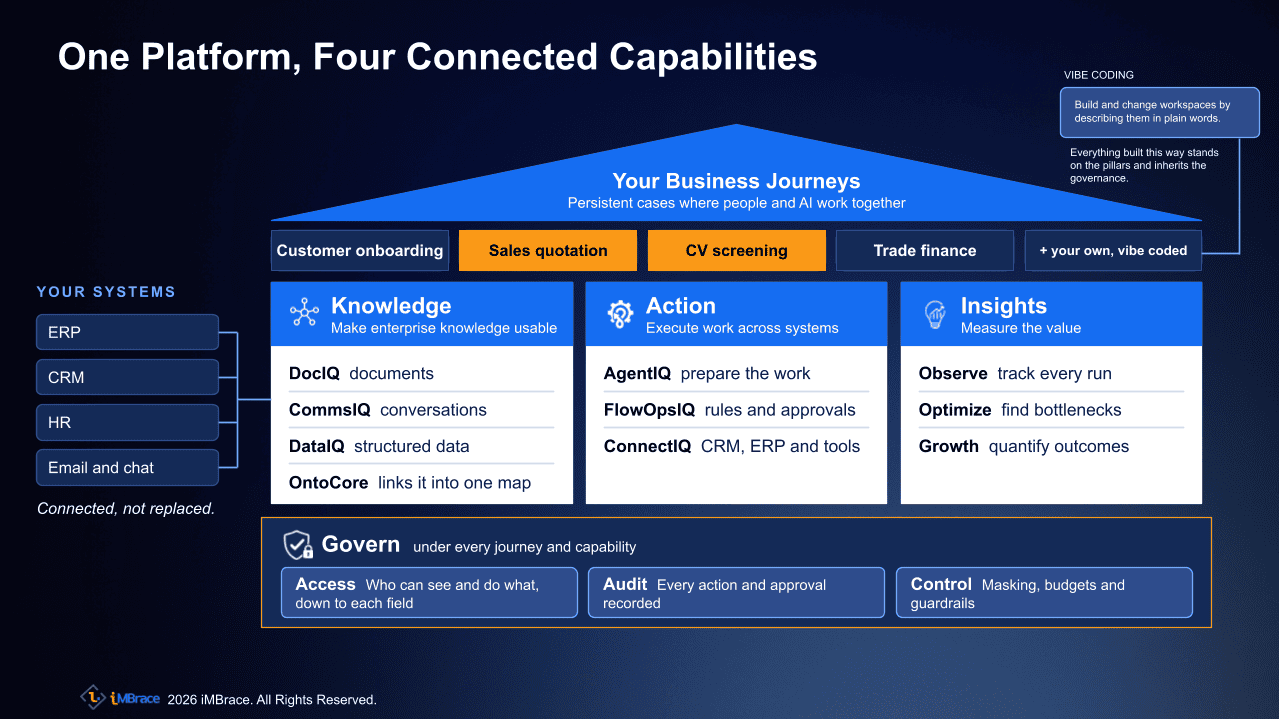
Knowledge reads the documents and knows the rules. DocIQ extracts the details from the LC, invoice, bill of lading, and certificates. OntoCore links each detail to the LC term and trade rule (UCP 600 or ISBP 745) it must meet. For example, if the bill of lading shows a shipment date later than the LC allows, the agent flags it and cites the exact clause.
Action decides who handles what. Details that match the LC are cleared automatically and logged, and staff supervise the results instead of approving each check (human-on-the-loop). Any discrepancy stops the process and goes to a named trade-finance officer, who decides whether to accept or refuse the documents (human-in-the-loop). The bank sets these rules in advance, so the AI only works within limits the bank has approved.
Insights shows when to change the rules. Observe records how each step performs, and Optimize highlights patterns, such as officers repeatedly overriding the same type of flag, which suggests the rule needs adjusting. If a check proves consistently accurate, the bank can let the AI clear it automatically. If errors appear, the bank can send that check back to an officer. The level of oversight is set by evidence, not guesswork.
Looking Ahead: Earning the Right to Step Back
The ART Framework is a starting point, not the final word. The HKMA’s upcoming discussion paper on agentic AI governance will look at intent-anchored accountability, a registry of material AI agents, and intervention mechanisms. Banks that can already answer four questions will be well positioned: What is each agent for? Who owns it? What is it allowed to access and do? How quickly can it be stopped?
Human-on-the-loop oversight lets banks benefit from the speed of agentic AI without weakening accountability. That only works when the boundaries, lineage, and evidence are built into the platform from the start.
See how iMBrace helps banks put the ART Framework into practice. Book a free demo with us today!
Stay tuned for more dynamic and collaborative events in our upcoming Event Highlight.