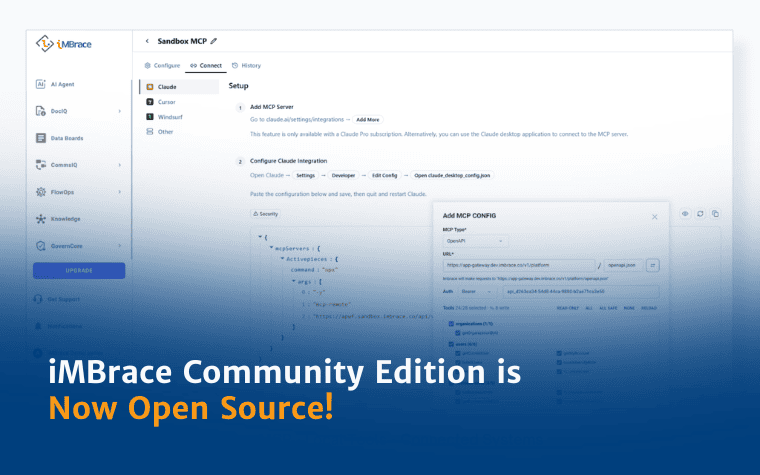


What is open source for enterprise and sovereign AI?
Open source for enterprise and sovereign AI refers to a model where AI code, models, and training content are publicly available under permissive licenses. This empowers your organization to:
- Inspect and adjust model behavior
- Fine tune models to match your enterprise needs
- Share enhancements with global developer communities
When paired with sovereign AI principles, such as on premise or private cloud deployment, human in the loop workflows, and comprehensive audit logs, this approach gives your enterprise the full control over data, systems, and compliance.
Why Open Source Boosts Sovereignty in Enterprise AI
- Full visibility and auditability
Open source models let you and regulators inspect architecture, model weights, and training steps, which is crucial for verifying accuracy, safety, and bias control. - Accountable decision-making
Transparent systems enable seamless integration of human-in-the-loop workflows and audit logs, enhancing governance, and verification for critical decisions. - Local control over data and systems
Deploying open source AI on-premise or in private clouds keeps models and data within your jurisdiction, which supports compliance with local regulations and infrastructure sovereignty. - Freedom from vendor lock-in
Open code allows you to self-host and customize without subscription costs or unpredictable vendor terms, which stabilizes long-term costs and reduces dependency.
What This Means for Your Enterprise
- You gain transparency to validate your AI systems under audit and compliance requirements.
- You retain sovereignty over your infrastructure, deployment, and data.
- You innovate faster through community contributions while staying compliant.
- You avoid hidden costs and risks tied to vendor lock-in.
Key Players in Open Source for Enterprise and Sovereign AI
NVIDIA
- Delivers performance through GPU-accelerated libraries like Triton and TensorRT.
- Supports open-source AI tools such as NeMo for generative AI and MONAI for health-imaging applications.
Amazon
- Developed DJL (Deep Learning Java), which enables Java-based deep learning.
- Supports open-source frameworks like TensorFlow and PyTorch through AWS managed services, which is ideal for enterprise-scale deployment.
Meta
- Released LLaMA, a family of open-source large language models.
- Created PyTorch and transferred stewardship to the PyTorch Foundation, promoting community-led innovation and neutrality.
How iMBrace Progressively Embraces Open Source Principles
iMBrace is built with open source foundations in mind, which reinforces sovereign AI for enterprise goals:
- Visible and adaptable AI pipelines
Key components such as model workflows, embedding layers, and inference operations use open source code. This enables teams to inspect, adjust, and audit the AI stack to meet internal compliance and governance needs. - Flexible deployment options
Designed for on-premise, private cloud, or hybrid setups, iMBrace supports the infrastructure control required for data sovereignty. This flexibility ensures sensitive data and models remain within your jurisdiction. - Modular and governed workflows
A block-based, no-code interface lets non-technical users construct AI pipelines that include human oversight and audit logging, which balances the agility with enterprise-grade security and traceability. - Built to integrate with open ecosystems
Supports major open models and tools such as LLaMA and NVIDIA GPU stacks, which enables your organization to incorporate cutting-edge innovation while preserving control over deployment and governance.
iMBrace Embeds n8n’s Open‑Source Workflow Builder
iMBrace integrates the powerful, open-source n8n workflow engine to provide a seamless, drag-and-drop experience for designing AI-powered workflows. This means both business and technical users can visually craft multi-step processes like approvals, data processing, or notifications without writing code, yet still add JavaScript or Python nodes when needed.
What this gives you:
- Instant accessibility , team members can build sophisticated automations through intuitive visuals.
- Developer-level flexibility , code nodes enable advanced custom logic without leaving the builder.
- Clear, transparent flows , the canvas visually maps each step, making it easy to audit, troubleshoot, and maintain.
By leveraging n8n’s proven architecture, iMBrace delivers a trusted and transparent foundation, combining enterprise-grade compliance and performance with the flexibility of open-source design.
Conclusion
Open source AI has become a transformative force that has ushered in a new era. From individuals, small businesses, to enterprises, everyone is adopting and investing heavily in open source AI. Like other technology domains, the open source philosophy has started to dominate the AI space and for very good reasons. Click here to discover more on how open source is powering the future of sovereign AI for enterprises.